
By Ma. Eliza J. Villarino, Rhys Bucknall-Williams, Laura Cramer, and Chiara Colombo Every year, UN climate negotiations pull together more than diplomats and ministers. They convene scientists, Indigenous leaders, civil society advocates, journalists and development practitioners — all united by a shared truth: the scale of the climate crisis demands collective action rooted in […]
The post Why we show up at climate COPs: Bridging local reality with global ambition appeared first onCGIAR.
The post Why we show up at climate COPs: Bridging local reality with global ambition appeared first on CGIAR.
]]>


Turn global ambition into grounded action, powered by science and shaped by communities.
The post Why we show up at climate COPs: Bridging local reality with global ambition appeared first on CGIAR.
]]>
The post appeared first onCGIAR.
The post appeared first on CGIAR.
]]>
When agricultural innovation endures beyond a project’s lifespan, it symbolizes true transformation. In Ogun State, Nigeria, a lead farmer’s consistent use of IITA’s AKILIMO recommendations has not only improved productivity but also earned formal recognition from the Ogun State Government and Prof. Ruth Oniang’o, Executive Director of the Rural Outreach Program and renowned advocate for […]
The post From Intervention to Transformation: How AKILIMO Continues to Shape Ogun State’s Agricultural Future and Success appeared first onCGIAR.
The post From Intervention to Transformation: How AKILIMO Continues to Shape Ogun State’s Agricultural Future and Success appeared first on CGIAR.
]]>Prof. Oniang’o, a respected leader in African agricultural development and former Kenyan parliamentarian, commended the farmer’s discipline and long-term commitment during a recent event. She emphasized that such consistency “reflects the transformative power of AKILIMO”, a tool designed to help smallholder farmers make evidence-based agronomic and business decisions. She added, “The farmer’s dedication to applying AKILIMO recommendations over the years embodies the essence of sustainable agriculture. It highlights the power of consistent effort and strong institutional support to transform livelihoods and ensure food security.” The farmer was especially lauded for successfully showcasing a thriving maize-cassava intercrop.
This acknowledgment underscores a vital truth: agricultural innovations remain relevant and effective years after training when institutional systems and farmer motivation align.
Driving Change through the OGADEP–AKILIMO Partnership
Since 2019, the Ogun State Agricultural Development Programme (OGADEP) has promoted AKILIMO technologies, working closely with IITA to strengthen the link between research and farmer practice. The partnership was solidified in 2020 when the Ogun State Ministry of Agriculture officially adopted AKILIMO as one of its approved extension materials. This endorsement enabled the integration of AKILIMO advisories into OGADEP’s extension system, ensuring that thousands of farmers nationwide benefit from site-specific agronomic guidance.
Through this collaboration, OGADEP leveraged its extensive network of field agents to conduct farmer trainings, establish demonstration plots, and facilitate community-level advisory services. Over 22,000 farmers (31% women) have been reached, and more than 500 extension agents and lead farmers have been trained, ensuring the continuity of AKILIMO delivery at the grassroots level. Farmers have reported notable improvements in fertilizer application efficiency, planting density, intercropping practices, and post-harvest management. These gains have translated into stronger linkages with markets and input suppliers, evidence that AKILIMO’s value extends beyond agronomy to support broader economic empowerment.
AKILIMO: From Tool to Transformative Model
IITA and its partners developed AKILIMO, initially designed as a digital decision support system to provide cassava farmers with tailored recommendations, including:
- Customized fertilizer recommendations
- Best practices for planting and weed control
- Optimal intercropping methods
- Scheduled planting and harvesting timelines
Farmers report significant improvements in their fertilizer use, spacing, and planting density knowledge. These gains have strengthened connections with markets and input suppliers.
Thompson Ogunsanmi, who coordinates AKILIMO use with OGADEP remarked, “Our commitment at IITA is to empower farmers with innovative tools like AKILIMO that deliver practical, science-based solutions. This recognition in Ogun State is a testament to how digital agricultural technologies can drive real, lasting impact on the ground.”
Over time, however, it has evolved into a comprehensive partnership-driven platform integrating public extension systems, private sector actors, and farmer organizations.
Farmers report significant improvements in their fertilizer use, spacing, and planting density knowledge. These gains have strengthened connections with markets and input suppliers.
The Ogun State experience highlights this evolution clearly, demonstrating that AKILIMO has evolved beyond a digital tool into a collaborative framework that empowers farmers, strengthens institutions, and enhances coordination across the agricultural value chain. The continued use of AKILIMO recommendations by farmers trained several years ago illustrates that sustainability is achievable when local ownership, institutional integration, and ongoing capacity building converge.
Institutional Ownership and Partnership for Sustainability
The enduring success of AKILIMO in Ogun State rests on deliberate efforts to embed the innovation within local systems, anchored in a comprehensive partnership with the Ogun State Agricultural Development Programme (OGADEP). Since 2019, OGADEP has been a key promoter of AKILIMO tools across the state.
Key factors supporting this longevity include:
- Institutional Integration: Embedding AKILIMO into OGADEP extension tools ensures sustainability.
- Local Ownership: State and local government area (LGA) commitment guarantees continuity beyond external projects.
- Community Structure: Lead farmers at the community level drive AKILIMO scaling through ongoing peer-to-peer learning and knowledge sharing.
The lead farmer structure, supported by OGADEP’s extension network, ensures continuous peer-to-peer learning and knowledge transfer at the community level. Institutional ownership at the state and local government levels has allowed the program to thrive beyond external funding cycles.
A critical milestone was reached in 2020 when the Ogun State Ministry of Agriculture officially adopted AKILIMO as part of its approved extension materials. This endorsement enabled seamless integration of AKILIMO advisories into OGADEP’s extension system, strengthening links with local farming communities through agronomic training and field demonstrations.
Through this vast network, OGADEP has delivered advisory services to over 22,000 farmers, including 31% women, trained more than 500 extension agents, and led farmers to ensure grassroots continuity.
A key driver of sustained collaboration is the AKILIMO Nigeria Association (ANA), a multi-stakeholder platform coordinating efforts to scale AKILIMO nationwide. ANA’s structure brings together public and private partners to align resources, share data, and co-develop strategies for scaling. This collective approach exemplifies how co-creation and coordination can transform an innovation into a movement.
Transparency in data and open access to partner information have also been critical for monitoring progress and refining approaches. As more institutions adopt digital monitoring and evaluation systems, AKILIMO’s framework offers a model for evidence-based decision-making and real-time learning within agricultural development programs.
Adapting to Challenges
Like any transformative initiative, AKILIMO’s journey in Ogun State has presented challenges that have shaped its growth. Limited resources and logistical constraints initially hindered field follow-up, prompting more efficient partner coordination and better prioritization of activities. Digital literacy gaps among farmers and some extension agents underscore the need for continuous training and inclusivity in digital agriculture.
Data reporting inconsistencies among certain partners highlighted the importance of technical support and performance incentives to sustain accountability. Yet these hurdles spurred innovation, leading to refresher trainings, improved digital reporting tools, and stronger partner engagement frameworks.
Another critical lesson has been the need for diversification. As AKILIMO expands to include maize and rice alongside cassava, it demonstrates flexibility and adaptability, ensuring that its recommendations meet the evolving needs of smallholder farmers across crops and regions.
A Testament to Enduring Innovation
The story of the Ogun State farmer recognized for sustained use of AKILIMO is a powerful reflection of what happens when innovation meets commitment and institutional support. It affirms that agricultural transformation is not just about introducing new technologies but about nurturing systems, people, and partnerships that ensure innovations take root and thrive.
Through collaboration with OGADEP, the continued leadership of ANA, and integration with OGADEP, AKILIMO proves that co-created digital solutions can drive meaningful, lasting change. Its success in Ogun State underscores a vital truth for agricultural development: when innovations are locally owned, supported by policy, and embedded within strong institutions, their impact transcends seasons, shaping livelihoods, empowering farmers, and inspiring transformation for years to come.
The story of this recognized farmer powerfully illustrates that when innovation is locally owned, policy-supported, and institutionally embedded, its impact transcends seasons, shaping livelihoods and inspiring transformation for years to come.
For more information about AKILIMO visit https://akilimo.org/
The post From Intervention to Transformation: How AKILIMO Continues to Shape Ogun State’s Agricultural Future and Success appeared first on CGIAR.
]]>
As the world grapples with intensifying climate shocks, the challenge of managing water for agriculture has never been greater. Erratic rainfall, shrinking aquifers, and unsustainable land use are stretching ecosystems and livelihoods to their limits. Yet amid this mounting crisis, scientists and policymakers are finding hope in data — and in a new generation of […]
The post Scientists develop new digital tools for enhancing water management in a changing climate appeared first onCGIAR.
The post Scientists develop new digital tools for enhancing water management in a changing climate appeared first on CGIAR.
]]>That was the focus of a recent webinar, “Water Impact Calculations and Natural Resource Management Tools,” which brought together researchers developing cutting-edge digital innovations to improve irrigation efficiency, bridge data gaps, and strengthen climate resilience from farms to entire river basins.
From need-based irrigation scheduling to digital natural resource dashboards and hydrological modelling under future climate scenarios, the webinar, hosted under CGIAR’s Multifunctional Landscape (MFL) Science Program, showcased how data-driven approaches are transforming how water and land are managed.

Water, data, and the productivity challenge
Water and land are the foundations of agricultural productivity. Yet both are under immense stress due to changing weather patterns, resource depletion, and inefficient management practices. Traditional irrigation often relies on fixed calendars rather than crop needs, leading to overuse or underuse of water and declining soil health. Meanwhile, much of the scientific data on soils, hydrology, and climate remains trapped in complex formats inaccessible to the farmers who need it most.
“Similar to land, water is a connector across the three Rio conventions – Biodiversity, climate, desertification/land degradation: How we measure, manage, and share it determines the sustainability of our landscapes” noted Cargele Masso, a Principal Scientist at ILRI, and leader, global engagement, science-based advocacy, and co-learning for the CGIAR multifunctional landscapes science program.
The webinar featured three complementary approaches that together offer a pathway to smarter water governance at the plot, landscape, and basin scales.
Smarter irrigation through a Water Impact Calculator
Kaushal K. Garg, a Principal Scientist in Natural Resource Management at ICRISAT, and an expert in landscape management and hydrology introduced the Water Impact Calculator (WIC), a tool developed to help farmers move from calendar-based to need-based irrigation scheduling.
“Irrigation is inevitable in modern agriculture, particularly in a climate crisis,” he explained; “ the challenge is how to do it efficiently so that we conserve water, reduce costs, and enhance yields.”
The WIC uses a field-scale water budget approach that factors in rainfall, soil moisture, evapotranspiration, and crop growth stages. By entering basic data on soil type, depth, irrigation method, and weather, farmers can determine exactly when and how much to irrigate, preventing both wastage and stress.
The WIC is being transformed into a user-friendly software platform . Beyond farm-level management, the tool can help researchers update decades-old FAO crop water coefficients using data from modern, drought-tolerant varieties. This could revolutionize irrigation planning across regions with physical or economic water scarcity.
Connecting landscape insights to farm decisions
While the WIC optimizes water use on individual plots, the Natural Resource Management (NRM) Tool, presented by Nagarjuna Reddy Nukala, an Associate Scientist in Soil Science at ICRISAT tackles a broader challenge: how to connect the wealth of landscape-level scientific data with the everyday decisions of farmers and extension agents.
“On one hand, we have complex scientific data on soils, water, and topography,” Reddy said. “On the other, farmers need simple, reliable answers for their specific plots. The challenge is bridging that gap.”
Developed under ICRISAT’s long-standing watershed management program, the NRM Tool integrates data from the Land Resource Inventory (LRI) and hydrological frameworks to offer a holistic view of the landscape. Through an interactive GIS dashboard, users can access parcel-level details on soil health, slope, and fertility; simulate cropping system designs under different rainfall scenarios; and generate fertilizer recommendations tailored to specific crops.
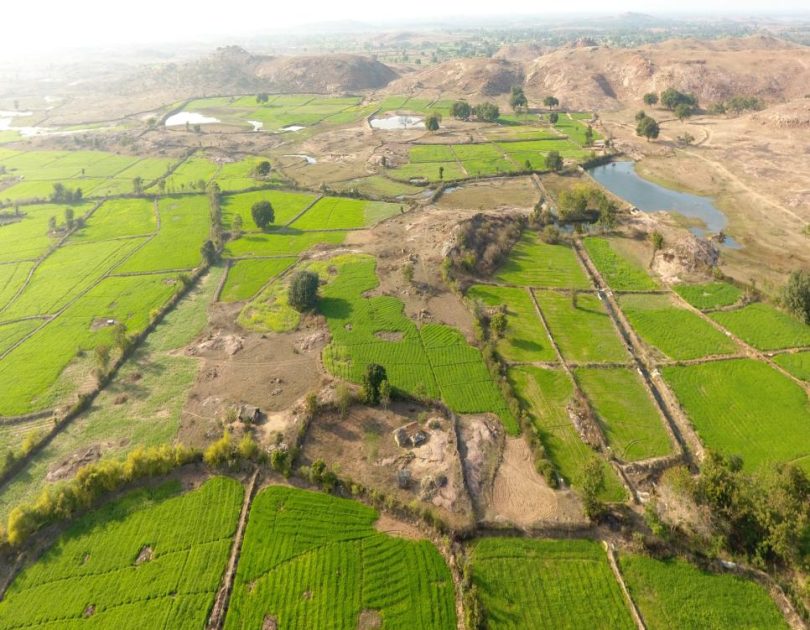
A pilot project in Bundelkhand, central India, demonstrated the tool’s potential. By combining soil maps at a 10-meter resolution with hydrological monitoring, the tool helped optimize the use of available resources, including nutrients, and in designing cropping systems. Farmers could visualize how interventions like rainwater harvesting and crop diversification affected water budgets in dry, normal, and wet years.
The NRM Tool is being tested by farmers and policymakers. The team aims to make it a public, open-source decision support system in 2026.
“This tool empowers both farmers and planners,” said Ramesh Singh, a Principal Scientist (Landscape Resource Conservation) and Theme Leader (Regenerative Landscapes) at ICRISAT who moderated the session. “It allows diagnostic-based, tailor-made solutions rather than one-size-fits-all recommendations.” While the tool is data-intense, it calls for public-private partnerships for integrated landscape management.

Modelling water under a changing climate
At a larger scale, Aiendrila Dey, a Consultant in Climate Modelling at ICRISAT, focusing on climate variability, hydrological extremes, and model-based risk assessment presented a multi-model framework for assessing blue and green water fluxes under climate change, a crucial step toward understanding how future rainfall and temperature shifts will affect water availability.
Her study, conducted in the Damodar River Basin in eastern India, compared three models: HYSIM, a simple conceptual model; SWAT, a semi-distributed, process-based model; and JULES, a fully distributed model incorporating fine-scale landscape data.
Results showed an expected increase in peak monsoon flows and reduced non-monsoon flows, underscoring the need for adaptive water storage and management strategies.
“Different models tell different stories,” Dey noted. “Using multiple models helps us understand uncertainty and make more robust decisions for climate adaptation.”
From data to policy: toward smarter governance
A key takeaway from the discussion was the need to align these digital innovations with national policy and investment priorities.
Ramesh highlighted that India’s Ministry of Rural Development is now integrating land resource inventory and hydrology data to guide rainwater harvesting strategies, a move that reflects the practical policy relevance of such tools. He added that the NRM Tool’s fertilizer module could support targeted subsidy reforms, reducing costs while protecting soil health.
“These tools offer science-based alternatives to blanket policies,” Ramesh said. “They can help governments and development partners invest where it matters most, in understanding and managing natural resources rather than subsidizing inefficiency.”
In many low- and middle-income countries, subsidies or financial supports often support inputs like fertilizers instead of investing in the biophysical knowledge needed for sustainability. “If we understand our landscapes better,” Cargele argued, “we can design interventions that are efficient, equitable, and environmentally sound.”
A digital future for water and land management
In closing, the speakers agreed that digital innovation is not about replacing traditional knowledge but enhancing it through data-driven insights. The three tools presented – WIC, NRM, and the hydrological modeling framework – together demonstrate how science can inform smarter, more resilient natural resource management at every scale. From field to watershed to basin, we must connect data, people, and policies to ensure water security in a changing climate
As water becomes an ever-scarcer commodity, such knowledge exchanges are vital. They remind us that technology, when grounded in science and scaled with empathy, can turn data into resilience and transform how humanity stewards the resources that sustain life itself.
By Wandera Ojanji
The post Scientists develop new digital tools for enhancing water management in a changing climate appeared first on CGIAR.
]]>
Hyderabad, India (25 October 2025)—India is redefining how rice breeding responds to consumer and market demand. To move beyond yield as the sole measure of success, experts are aligning breeding pipelines with grain quality, market fit, and consumer preferences. To advance this shift, the International Rice Research Institute (IRRI), CGIAR, and the Indian Council of […]
The post Less Is More in India’s Upcoming Rice Breeding Strategy appeared first onCGIAR.
The post Less Is More in India’s Upcoming Rice Breeding Strategy appeared first on CGIAR.
]]>To advance this shift, the International Rice Research Institute (IRRI), CGIAR, and the Indian Council of Agricultural Research (ICAR) convened a National Consultation on Market-Demand Segmentations and Breeding Pipelines for India at the ICAR–Indian Institute of Rice Research (IIRR) in Hyderabad. Held under the IRRI–ICAR Work Plan Thematic Areas 1 & 2 and the CGIAR Breeding for Tomorrow (B4T) initiative, The event brought together more than 70 scientists, breeders, and private-sector partners to align India’s rice breeding strategy with evolving consumer trends.
The post Less Is More in India’s Upcoming Rice Breeding Strategy appeared first on CGIAR.
]]>
In October 2025, conservationists, policymakers and academics gathered in Abu Dhabi for IUCN’s World Conservation Congress, to establish a 20-year Strategic Vision for nature conservation, titled “United for Nature”. This vision aims to ensure that societies around the world conserve nature’s integrity and diversity, use natural resources equitably and build a just and nature-positive future […]
The post Launch of “The Business Case for Investment in Rangeland Restoration” at IUCN World Conservation Congress, Abu Dhabi appeared first onCGIAR.
The post Launch of “The Business Case for Investment in Rangeland Restoration” at IUCN World Conservation Congress, Abu Dhabi appeared first on CGIAR.
]]>An important part of this vision is that rangelands and those dependent on rangelands receive adequate investment and support for more sustainable livelihoods as well as building resilience to climate change, the conservation of globally important biodiversity and ecosystem services.
Restoring rangelands that have been degraded by invasive species or others, is a key investment area. The launch of The Business Case for Investment in Rangeland Restoration produced by the Economics of Land Degradation Initiative (ELD) and ILRI, financed by the German Federal Ministry for Economic Cooperation and Development with in-kind support from the GEF-funded STELARR project lays out a roadmap for how this can be achieved.
 Rangeland restoration: An investment case with high potential
ELD’s Business Case for Investment in Rangeland Restoration report shows that restoring degraded rangelands is not only viable from an environmental and social perspective but also can generate economic returns. Rangelands cover more than half of the Earth´s land surface. They feed hundreds of millions of people, store vast amounts of carbon and diverse biodiversity including many IUCN Red List species. Yet investment in protection and restoration of rangelands is far behind that of forests. The report highlights that rangelands can deliver multiple benefits from improved livestock production to carbon sequestration, water regulation or tourism opportunities among others.

To unlock this potential, it calls for:
· Stronger land tenure and governance
· Targeted restoration measures and economic incentives
· Innovative financing and market infrastructure
· Inclusive participation of pastoralist communities
· Better cost–benefit analysis and monitoring systems
Restoring rangelands does not come with a one-size-fits-all solution. Costs vary widely depending on the type and severity of degradation. By combining revenue streams from livestock production carbon and biodiversity credits, eco-tourism and renewable energy among others. Diversifying revenues can reduce risk and attract investors. Pastoralists the main users and custodians of these lands are co-investors through their labour, knowledge and stewardship of the land. Supporting them strengthens the social foundations of restoration and ensures that economic returns can be shared more fairly.
Positioning rangeland restoration as a key priority under the IYRP 2026
The Business Case for Investment in Rangeland Restoration lays a strong foundation for positioning rangeland restoration as a key priority under the upcoming International Year of Rangelands and Pastoralists (IYRP) 2026. The year offers a significant opportunity to raise awareness on the importance of rangelands and the dire need for investment in restoration. Initiatives such as STELARR and UNCCD’s Business4Land provide openings for greater private sector investment. By working together, we can ensure that these valuable land use ecosystems receive the attention that the deserve.
The report can be accessed on ELD´s website :
Acknowledgement
Funded by the Global Environment Facility, STELARR is being implemented by IUCN and executed by ILRI in partnership with the Alliance of Bioversity International and CIAT, International Center for Agricultural Research for Dry Areas (ICARDA), Center for International and World Agroforestry Centre Forestry Research (CIFOR-ICRAF), the Secretariat of the UN Convention to Combat Desertification (UNCCD), and the Sustainable Fibre Alliance. Additional research support is provided by the CGIAR Science Program on Multifunctional Landscapes. ILRI thanks all its donors including those that contribute to the CGIAR Trust Fund.
The post Launch of “The Business Case for Investment in Rangeland Restoration” at IUCN World Conservation Congress, Abu Dhabi appeared first on CGIAR.
]]>
By Maha Al-Zu’bi (IWMI & CGIAR Scaling for Impact Program AoW2 Focal Point) In an era of climate stress, water scarcity, and geopolitical complexity, one truth stands out: managing water, energy, food, and ecosystems separately no longer works. The challenges are deeply intertwined -and so must be the solutions. That’s the spirit driving the upcoming […]
The post Scaling for Impact: Integrating WEFE Nexus Innovations Across Borders and Sectors appeared first onCGIAR.
The post Scaling for Impact: Integrating WEFE Nexus Innovations Across Borders and Sectors appeared first on CGIAR.
]]>In an era of climate stress, water scarcity, and geopolitical complexity, one truth stands out: managing water, energy, food, and ecosystems separately no longer works. The challenges are deeply intertwined -and so must be the solutions.
That’s the spirit driving the upcoming regional webinar “Scaling for Impact: Integrating WEFE Nexus Innovations Across Regions and Sectors,” jointly organized by IWMI, the CGIAR Scaling for Impact (S4I) and Policy Innovations programs, and the Blue Peace Initiatives in Central Asia.
On November 11, 2025, experts, policymakers, and practitioners from across regions will convene online to explore how governance innovations and institutional coordination can help scale the Water–Energy–Food–Ecosystems (WEFE) Nexus in transboundary settings – from the Tigris-Euphrates, Yarmouk to the Amu Darya basins.
From Concept to Cooperation
Despite its growing recognition in research and policy, implementing the WEFE Nexus remains a challenge. Institutional silos, fragmented mandates, and uneven access to data continue to impede collective action. Yet, across the Middle East and Central Asia, there are signs of progress: community-led water management, digital modeling tools, cross-sector partnerships, and youth-driven innovations are reshaping how shared resources are governed.
The webinar aims to bring these stories together — creating a shared space to connect innovations, identify enabling conditions, and chart practical pathways for scaling.
A Dialogue for Scaling and Solidarity
The 90-minute session will go beyond theory, offering an interactive dialogue on what it takes to translate WEFE Nexus principles into policy and investment action.
Participants will discuss enabling arrangements for scaling, such as:
- Policy coherence and legal harmonization across borders
- Strengthened research-policy linkages
- Inclusion of women, youth, and marginalized groups

Join the Conversation
Date: November 11, 2025
Time: 3:30–5:00 PM (Uzbekistan)
Format: Online (with English and Russian interpretation)
By bringing together diverse voices—from researchers to regional policymakers, the session aims to turn knowledge into action, and innovation into impact.
Because when regions collaborate, scaling for impact becomes not only possible—but transformative.
The post Scaling for Impact: Integrating WEFE Nexus Innovations Across Borders and Sectors appeared first on CGIAR.
]]>
In a country where a good percentage of the population are farmers, there is extreme poverty, which, according to a World Bank report, affects over two-thirds of the population. In South Sudan, the heavy reliance on food importation is not a tale, but a pressing national crisis. Despite 95% of the population relying on agriculture, over 78% live in […]
The post Empowering South Sudan farmers to unlock agricultural potential appeared first onCGIAR.
The post Empowering South Sudan farmers to unlock agricultural potential appeared first on CGIAR.
]]>Despite 95% of the population relying on agriculture, over 78% live in poverty. As one of the world’s most climate-vulnerable countries, South Sudan is affected by erratic rains, drought, and conflict, leaving 54% of people, especially women and children, in a state of food insecurity. The key to breaking this cycle lies in the speedy growth of the agricultural sector and using it as the primary tool to achieve lasting food security.
IITA–CGIAR, in collaboration with the government of South Sudan through its Ministry of Agriculture and Food Security (MAFS) and Food and Agriculture Organization (FAO), is exploring ways to embed CGIAR technologies and innovative solutions into existing country programs such as the Climate Resilient Agri-Food Systems Transformation (CRAFT-1). This will help build pathways for transforming the country’s agricultural sector and strengthen MAFS’ agricultural research capacity for sustainable agricultural development, thereby boosting the country’s economic growth.
The post Empowering South Sudan farmers to unlock agricultural potential appeared first on CGIAR.
]]>